The Needham History Center & Museum and the Needham VFW are working to create a memorial honoring all known Needham veterans of the Revolutionary War, not just the five men killed at Arlington on April 19, 1775.
Gloria Polizzotti Greis, executive director of the Needham History Center & Museum, and Tom Keating of the Needham VFW have compiled a list of 354 Needham men who fought in the Revolution. The pair are aiming to unveil the memorial in spring 2027, possibly in April, according to Greis.
Getting to that number was harder than expected.
The researchers relied heavily on Massachusetts Soldiers and Sailors in the Revolutionary War, a 17-volume compendium published in 1897 by the Secretary of the Commonwealth that transcribes records from the State Archives. The collection is digitized and searchable, but each enlistment was a separate record, and variant spellings meant a single person could appear multiple times. Greis cited the example of one soldier listed as Uriah Coller, Colar, Collar and Chollor. Families also reused names across generations, adding layers of confusion.
After weeding out duplicates, the researchers settled on 354 names.
Among them are soldiers whose Needham ties have been largely forgotten. Part of what is now Natick was actually part of Needham from about 1716 until 1797, an extension of land known as the Needham Leg. That area included Native American and mixed-race residents connected to John Eliot's Natick Praying Indian community, established in the 1600s. A whole militia company from Natick was made up of Native American and Black soldiers, according to Greis. Those who lived in the Leg were citizens of Needham at the time of the war.
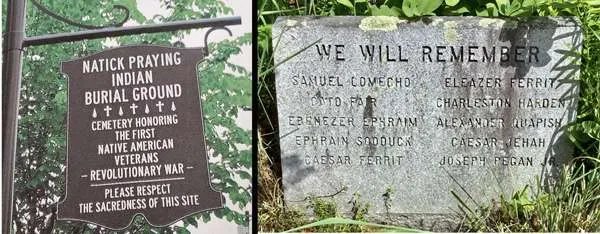
One veteran's story stands out. Alexander Quapish, a Wampanoag man born around 1741 in Yarmouth, moved to Dedham and married Sarah David, a member of the Natick Praying Indian community, in 1767. They had at least one child, a daughter named Alice. Sarah died in 1774.
Quapish enlisted in Captain Daniel Whiting's Company of the Colonial militia in 1775. He was one of about 50 Wampanoag men who volunteered for the Continental Army after the Lexington Alarm, hoping their service would lead to greater self-determination after the war. He served at Bunker Hill and in Cambridge.
He fell ill in Cambridge in November 1775 and was taken to the Needham home of fellow militiaman Michael Bacon, where he died in March 1776. Bacon later petitioned the Massachusetts General Court for reimbursement, writing that Quapish "was taken Sick in the Army Near Cambridge and was Dismised Came to the House of your Petitioner in Said Needham in a Suffering Condition on the 15th Day of November 1775 And Remained there Sick untill the 23d Day of March 1776 and then Died."
The Needham Selectmen endorsed the petition.
Quapish's story took a darker turn in the 1850s. By then his remains were in Dedham. Whether they had been moved from an original burial near the Bacons or were buried in Dedham from the start is unclear. In 1856, Dr. Henry Jacob Bigelow disinterred the remains and gave them to the Warren Anatomical Museum at Harvard Medical School.
The remains stayed at Harvard until a review under the federal Native American Graves Protection and Repatriation Act, known as NAGPRA, passed in 1990. The law requires museums holding Native American human remains to audit their collections and return identified remains to the appropriate tribe. Harvard contacted representatives of three Wampanoag-affiliated tribes: the Mashpee, the Gay Head/Aquinnah and the Assonet Band.
In December 2020, Quapish was reburied at the Natick Praying Indian Burial Ground on Pond Street in South Natick, in a ceremony with Wampanoag and Nipmuc participants overseen by the late Chief Caring Hands of the Natick and Ponkapoag Praying Indians. At least 17 Native American militia members are buried in that cemetery.
The planned Needham memorial does not yet have a confirmed date or location. Updates are expected from the Needham History Center and the Needham VFW as the project moves forward.