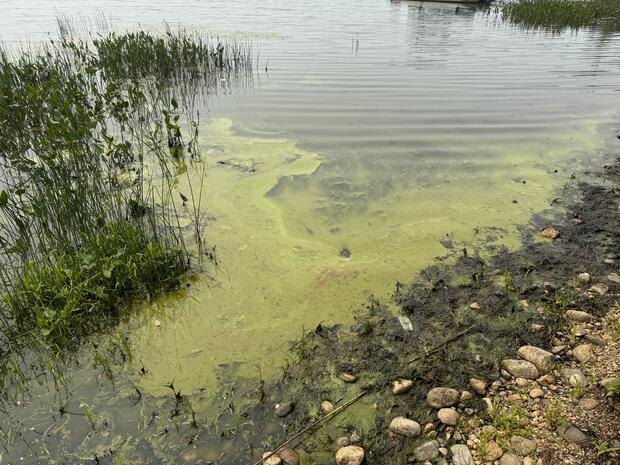
State health officials are testing Rosemary Lake in Needham for a possible toxic algae bloom, and the town is telling residents and pets to stay out of the water until results come back.
The Town of Needham posted the public health advisory Wednesday, Aug. 26, after the Massachusetts Department of Public Health (MDPH) began testing the lake for cyanobacteria, also called blue-green algae. The advisory is open-ended: no fishing, no water contact, and no pets near the shoreline until further notice.
Anyone who does touch the water should rinse off immediately, the town said.
Health risks
Cyanobacteria can release toxins during rapid growth periods. According to MDPH guidance, swallowing even small amounts can cause gastrointestinal symptoms, while larger exposures may lead to liver or neurological damage. Skin and eye irritation can result from direct contact, and inhaling water spray near a bloom can trigger asthma-like symptoms.
Small children and pets face the greatest risk. Dogs have been known to eat algae scum that washes ashore or lick it from their fur. Pet owners should call a veterinarian immediately if a dog shows vomiting, staggering, drooling, or convulsions after being near the water. Canine deaths from harmful algae ingestion have been documented in Massachusetts, according to a Boston Public Health Commission advisory.
Whether a bloom is toxic cannot be determined by sight alone; only lab analysis can confirm the presence of cyanotoxins.
Charles River advisory lifted
The same Aug. 26 posting carried a separate update. MDPH lifted the cyanobacteria advisory it had issued July 21 for the Charles River between Kendrick Street and Nahanton Street in Needham and Newton and Bridge Street and Spring Street in Dedham and West Roxbury. That advisory had covered Millennium Park, Cutler Park Reservation, and surrounding stretches of the river.
The Charles River advisory had been in place for more than five weeks. On Aug. 3, DPH confirmed benthic cyanobacteria mats around Millennium Park and floating chunks on the water surface, according to a Dedham town update. The Charles River Watershed Association noted in an Aug. 21 release that 2026 marked the third consecutive summer the river experienced a cyanobacteria bloom.
To lift an advisory, DPH requires two rounds of water samples collected a week apart that fall below 70,000 cyanobacteria cells per milliliter.
What's next
The town said it will post updates on the Rosemary Lake situation as more information becomes available. Residents can check mass.gov/algae-blooms for a statewide list of waterbodies under active advisories.